Oiled Wildlife Response Workshop
In February, the Wildlife Health Program hosted the Tri-State Bird Rescue & Research, Inc. (TSBRR) team for an in-depth training course on how to respond to an oiled-wildlife event. The 8-hour workshop provided education on how to properly respond to wildlife affected by an oil spill.
The workshop was split into two tracks. Lectures covered regulations and agencies, human health and safety, field and transport operations, data collection and chain of custody, response facility requirements, and animal care.
We held a practical exercise using bird carcasses to simulate the oil decontamination process, which included appropriate PPE use. Demonstrations incorporated steps that help minimize stress and prevent harm to affected birds.
Under the Scope...
Electrocution in a bald eagle
In February, a bald eagle was found in bushes below a power line tower in Suffolk County. At necropsy, the adult female was in good body condition with a crop full of food and talons clenched around nesting materials. There were extensive burns on the skin and a large laceration with exposed bone on one of the wings. There was widespread charring of the feathers on the body, significant burn damage to both wing and tail feathers, and trauma to the musculature and several internal organs. These findings, along with the history, confirmed that this eagle died from electrocution from the power line.
Avian mortality due to power line electrocution is not uncommon, with large raptors like eagles, hawks, and owls most affected. Electrocution occurs when a bird makes contact with two pieces of electrical equipment or electricity and a grounded object. For large raptors, like eagles, this is usually contact with two wires or between a wire and a pole or equipment without insulation. (Electrocution of Raptors on Power Lines -R. A. Kagan, 2016.)
Program happenings in the field and in the lab
Latest Presentations
2026 BOW meeting
- Jenny Bloodgood “Update on highly pathogenic avian influenza”
- Kevin Hynes "Wildlife Forensic Casework"
- Colby Plant "Anticoagulant rodenticides in non-target wildlife"
Furbearer & Small Game Mammal Management Team Meeting
- Jenny Bloodgood "Research Updates"
Latest Publications/Podcasts/News
- Day in the Life of a DEC...Kevin Hynes. CWHL website
- Normal reproductive anatomy and description of two vasectomy approaches in the North American beaver (Castor canadensis). Journal of Zoo and Wildlife Medicine
Training Events & Outreach
Chemical Immobilization Course. Ithaca, NY
Cornell Zoo & WIldlife Society (ZAWS). Ithaca, NY
- Outbreak Response Investigation demonstration
- Chronic Wasting Disease Sampling Lab
One Health Symposium
- Outbeak Response Lab
Skype-A-Scientist
- HOSA – Future Health Professionals
- Science National Honor Society
4-H Climate Action/Nature & Outdoor Education
- The Science of Nature and Wildlife Forensics
- “What’s in the water? Environmental DNA!”
Disease stats
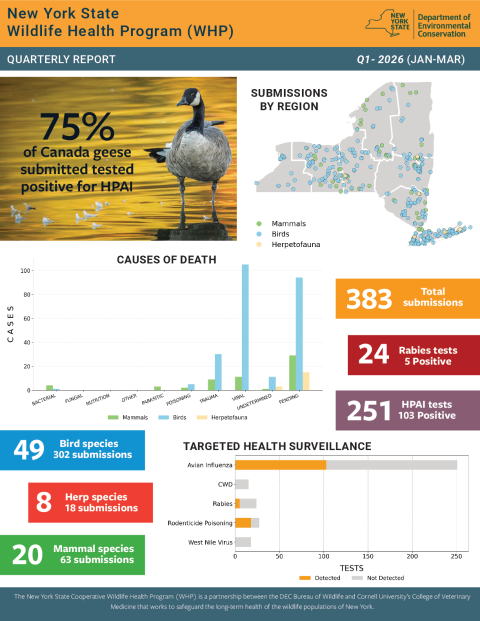
383 total submissions
24 Rabies tests - 5 positive
251 HPAI tests - 103 positive *75% of Canada geese submitted, tested positive for HPAI
49 Bird species across 302 submissions
8 Herp species across 18 submissions
20 Mammal species across 63 submissions