Quick Reference Guide
EHD Hemorrhagic disease is a general term for illness caused by two different viruses that are related: Epizootic Hemorrhagic Disease virus (EHD) or bluetongue virus (BT).
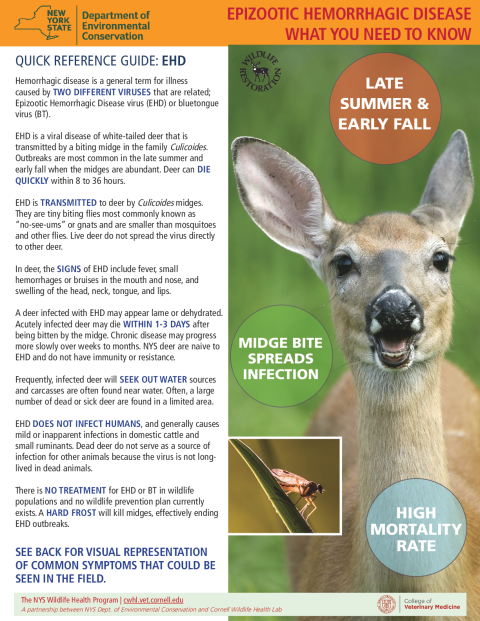
EHD is a viral disease of white-tailed deer that is transmitted by a biting midge in the family Culicoides. Outbreaks are most common in the late summer and early fall when the midges are abundant. Deer can die quickly within 8 to 36 hours.
EHD is transmitted to deer by Culicoides midges. They are tiny biting flies, most commonly known as “no-see-ums” or gnats, and are smaller than mosquitoes and other flies. Live deer do not spread the virus directly to other deer.
In deer, the signs of EHD include fever, small hemorrhages or bruises in the mouth and nose, and swelling of the head, neck, tongue, and lips.
A deer infected with EHD may appear lame or dehydrated. Acutely infected deer may die within 1-3 days after being bitten by the midge. Chronic disease may progress more slowly over weeks to months. NYS deer are naive to EHD and do not have immunity or resistance.
Frequently, infected deer will seek out water sources, and carcasses are often found near water. Often, a large number of dead or sick deer are found in a limited area.
EHD does not infect humans, and generally causes mild or inapparent infections in domestic cattle and small ruminants. Dead deer do not serve as a source of infection for other animals because the virus is not long-lived in dead animals.
There is no treatment for EHD or BT in wildlife populations, and no wildlife prevention plan currently exists. A hard frost will kill midges, effectively ending EHD outbreaks.