

Trichinellosis (trichinosis) is a zoonotic, parasitic disease caused by various species of roundworms in the genus Trichinella. There are currently 13 recognized species and genotypes of the parasite.
The parasite primarily infects carnivores. Most mammals are susceptible, and some Trichinella species can also affect birds and reptiles. In the United States, the most common species are T. spiralis, T. nativa, T. pseudospiralis, and T. murrelli.
Humans can also become infected when consuming undercooked meat. Many Trichinella species are associated with infection in humans and may be related to the consumption of wildlife.
Trichinellosis does not typically cause clinical signs in wildlife, but it can cause clinical disease in humans. The severity of human trichinellosis can vary from asymptomatic infection to fatal disease.
Transmission occurs via the consumption of infected meat that contains larvae.
There are several methods to diagnose trichinellosis, though most wildlife infections remain undiagnosed. Using microscopic examination of muscle tissue, artificial digestion of muscle tissue, serology, or molecular tests are standard testing mechanisms.
There is no treatment for trichinellosis in animals. Prevention in wildlife is not feasible because the parasite’s life cycle is naturally maintained through predation
and scavenging
Trichinellosis is observed globally but is most common in the United States and some areas of Europe.
Historically, human cases in the United States were mainly associated with raw or undercooked pork consumption. Cases have greatly decreased due to improved pork management and food safety techniques. Human cases from consumption of wildlife are becoming increasingly important.
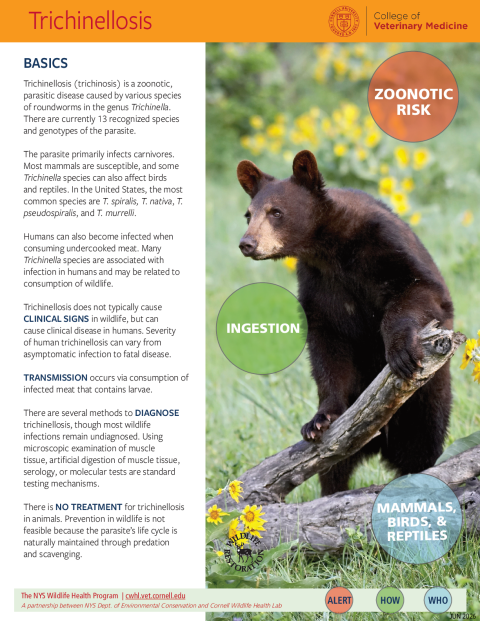
Trichinella spp. can infect mammals, birds, and reptiles. It primarily affects carnivores and omnivores. It has been documented a wide range of mammals, including bears (black, grizzly, polar), foxes (arctic, red, gray), wild boars, coyotes, gray wolves, cougars, bobcats, lynxes, raccoons, skunks, fishers, wolverines, and walruses.
Affected reptiles include saltwater crocodiles, soft-shelled turtles, Nile crocodiles, and monitor lizards. The parasite has also been found in multiple bird species including the golden eagle, peregrine falcon, common kestrel, tawny owl, and more.
Trichinella infection does not typically cause illness in domestic swine or wildlife.
Transmission occurs via consumption of animal tissue infected with Trichinella larvae. Larvae are released from the tissue during digestion and invade the host’s small intestinal mucosa. There they develop into adult worms that reproduce and release large numbers of larvae that migrate to skeletal muscle.
Most Trichinella species that infect mammals form cysts in the muscle tissue, where the larvae may remain viable for years. Larvae are most commonly found in the diaphragm, tongue, intercostal, and masseter (cheek) muscles.
Trichinella species that infect birds and reptiles are non-encapsulated, meaning they do not form cysts and can be more distributed throughout the muscle tissue.
Trichinellosis cannot be transmitted from person to person.
There are several methods to diagnose trichinellosis, though most wildlife infections remain undetected. Microscopic examination of muscle tissue samples may be used to diagnose but may not rule out an infection because not all muscle will contain the parasite. The gold-standard diagnostic test used in animals uses hydrochloric acid-pepsin solution to digest the muscle tissue; experienced personnel microscopically examine the residue for larvae. Serological and molecular diagnostic tests are also available. In humans, muscle biopsies can be performed to identify larvae.
In humans, treatment usually includes anthelmintics and, in severe cases, corticosteroids.
Many Trichinella species are associated with infection in humans and related to consumption of wildlife. Cysts containing larvae can survive for long periods of time in extreme conditions, including freezing. Therefore, meat from wildlife that will be consumed by humans should be appropriately cooked (internal temperature of at least 165 F) to kill larvae. Other preservation methods (e.g., smoking, curing, drying, salting) will not kill the parasites.
Additionally, appropriate hygienic practices (e.g., thorough handwashing before and after handling meat, disinfecting surfaces and utensils that meat contacted) should always be implemented. As a general recommendation, individuals should not handle or consume meat from ill wildlife. Molecular tests are generally not recommended for pre-consumption testing because the larvae are unevenly distributed and false negatives are possible.