Highly Pathogenic Avian Influenza Update
Avian influenza virus infections follow a seasonal pattern tied to bird migration, with cases peaking in late fall and winter. HPAI has been detected in 13 counties in raptors and waterfowl and one striped skunk. WHP began receiving reports of larger mortality events (20+ birds) in Regions 3 and 8 in fall of 2025. In Region 8, these cases spiked in early December with a steadily increasing number of calls from the public about suspected and confirmed HPAI birds.
Reports include multiple incidents involving large groups of geese that were unable to be collected because of their location. Reports of public interactions with sick wildlife have also increased.
Please visit our Highly Pathogenic Avian Influenza Disease Watch page for ongoing updates, safety guidance, and a link to the DEC HPAI Reporting Tool.
Under the scope
Squirrel Alopecia
Multiple squirrels were found dead within a few days at the base of the same tree in a yard in Oneida County. Several of them were reported to be hairless. One hairless red squirrel was submitted for necropsy. At necropsy, the squirrel had generalized bilaterally symmetrical alopecia affecting the trunk, proximal limbs, and back of the ear pinnae; there was normal hair on the head, feet, and tail only. There were also multiple puncture wounds consistent with cat bite trauma observed and the cause of death was determined to be predation, likely by a cat.
Histopathology of the skin was performed and bent hair follicles, hairs perpendicular in the follicle, and clumping of melanin in the hair shafts were observed. These findings are consistent with Red Squirrel Follicular Dysplasia. This condition has been described in red squirrels in New York, but the pathogenesis is not fully understood and a genetic etiology is suspected (Gordon et al. 2023). This condition likely predisposed the squirrel to predation.
Program happenings in the field and in the lab
In the Field with the DEC
- Marten sampling in October and December with Jenny
- CWD lab in Region 7 with Jenny and wildlife vet interns
CWD sampling at John White Farm with Krysten, Jenny, and Melissa
Latest Presentations
- Jenny Bloodgood, “Update on highly pathogenic avian influenza” and "NYS Wildlife Health Program Overview," NYS Wildlife Rehabilitation Council Meeting. Corning, NY.
- "Free-ranging wildlife health and disease research to inform conservation" Cornell Dual Degree Symposium. Ithaca, NY
Latest Publications/Podcasts/News
- New World Screwworm Fact Sheet now available
- Novel method for collecting skin microbiome samples from free-ranging bottlenose dolphin. Marine Mammal Science
- Awarded "Capacity Building for Rapid Response to Chelonian Confiscation" grant to support development of a diagnostic assay for multiple turtle pathogens.
Educational Events
- Outbreak Response Investigation demonstration. Cornell Zoo & Wildlife Society (ZAWS). Ithaca, NY
- Marine Mammal Pathology Rounds. Virtual
Disease stats
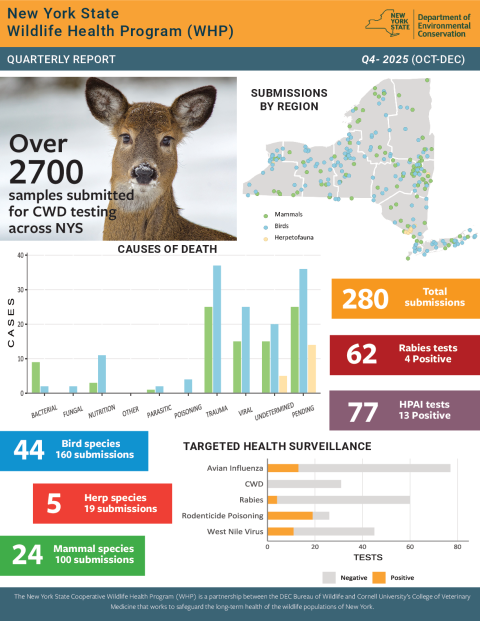
280 total submissions
62 Rabies tests - 4 positive
77 HPAI tests - 13 positive
44 Bird species across 160 submissions
5 Herp species across 19 submissions
24 Mammal species across 100 submissions - *over 2700 samples submitted for CWD testing across NYS