

What diseases might hunters see in deer this fall?
There’s a few different disease issues we commonly see in New York white-tailed deer. The most obvious is hemorrhagic diseases (EHD and blue tongue) with deer found dead, often near water. Surviving deer might have splitting or cracking hooves. Fibromas are obvious, but harmless, unless they interfere with sight or feeding, masses that occur anywhere on a deer. Bucks will get brain abscesses around the base of the antler (pedicle), particularly if that antler has been injured. We are on the lookout for CWD, so any reports of sick or abnormal deer should be investigated. If a hunter harvests a deer and then has concerns, they can surrender it and receive a replacement tag. Ideally, intact (not field-dressed) deer can be submitted for a full postmortem evaluation. CWD tests require the head for specific samples of the obex (brainstem) and lymph nodes found behind the lower jaw. Hunters wanting a CWD test on their own deer tested can visit the Cornell Wildlife Health Lab Hunter Harvest Testing page for more information.
Under the Scope
Oral lesions in a Red-tailed hawk
A fledgling red-tailed hawk found dead in Central Park was submitted to the Wildlife Health Unit for examination. During necropsy, a cheese-like lesion was found in the hawk’s mouth, affecting approximately half of its oral cavity. Following necropsy and histopathology, it was determined to be trichomoniasis. Avian trichomoniasis is caused by Trichomonas gallinae, a single-celled protozoan parasite. It is typically seen in pigeons and doves, but spreads to raptors that consume infected birds. It is often identified through the yellow-white, caseous (cheesy) mass in the mouth and esophagus, which can cause starvation and suffocation in young birds by obstructing the esophagus and/or trachea. Trichomoniasis can be treated in birds with the use of an oral medication, but this treatment method is not practical for wild birds. The public can prevent the spread of trichomoniasis and other pathogens by cleaning and disinfecting their bird feeders and baths regularly with a 10% bleach solution.
Program happenings in the field and in the lab
In the Field with the DEC
- Bat banding-R4 & hellbender sampling-R9 with Jenny & Melissa
- Fish seining-R4, waterfowl banding & HPAI sampling-R6, and Grassland bird surveys-R8 with Jenny and wildlife interns
Latest Presentations
- Krysten Schuler “Is Chronic Wasting Disease Inevitable?” The Wildlife Society Trilateral Webinar Series. Virtual. “How can we get to wildlife health intelligence?” Wildlife Disease Association. BC, Canada.
- Kevin Hynes “Wildlife Damage Management.” Lecture and necropsy demonstration. SUNY Cobleskill.
- Brenda Hanley “Sample Size in Raptor Health.” Cornell Raptor Consortium. Ithaca, NY. “Thank you for clustering.” Biometrics Working Group, The Wildlife Society. Virtual.
- Jenny Bloodgood “Safe Handling and Field Sampling” and “Common Diseases, Animal Care, and Euthanasia” Waterfowl Banding Workshop. DEC Region 6. “Bobcat population health in New York state.” Poster presentation, Wildlife Disease Association. BC, Canada.
Latest Publications/Podcasts/News
- Strategic planning of prevention and surveillance for emerging infectious disease. PNAS
- Wildlife conservation gets down to business. Cornell Chronicle
- Doing More with Less. CWHL website
- Beware! Your Halloween decorations could be a nightmare for wildlife. Popular Science
Disease stats
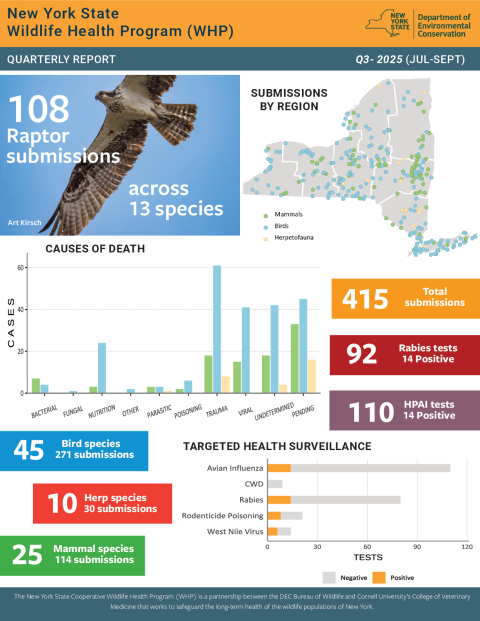
415 total submissions
92 Rabies tests - 14 positive
110 HPAI tests - 14 positive
45 Bird species across 271 submissions - *108 raptor submissions across 13 species
10 Herp species across 30 submissions
25 Mammal species across 114 submissions