

New Chemical Immobilization Training Course
On May 19-20, 2025, the Wildlife Health Program hosted the first annual New York State Wildlife Health Program Chemical Immobilization Training for DEC Biologists and Environmental Conservation Officers. Twenty-three DEC employees attended the event. The 1.5-day event, led by Dr. Jenny Bloodgood, included didactic lectures at Cornell University College of Veterinary Medicine, followed by a hands-on lab at Reynolds Game Farm. Attendees learned about the reasons for chemical immobilization of wildlife, rules and regulations of controlled substances, common drugs used and how to calculate doses, equipment use and care, animal care, and human safety. The hands-on portion included a range of exercises with various projectors, using pole syringes, drawing up drugs and loading darts, and removing darts from an animal. This comprehensive training equipped participants with the foundational knowledge and practical skills necessary to safely and effectively perform chemical immobilization of wildlife in the field.
Under the scope
Tularemia in beavers
Two beavers were found dead along a hiking trail near a creek in Chautauqua County. Necropsy revealed multifocal pale white (necrotic) foci throughout the lymph nodes, lungs, spleen, and liver in both beavers. The constellation of changes observed on gross necropsy and histopathology were consistent with tularemia and tissues were positive via PCR for Francisella tularensis, the causative agent for tularemia. Tularemia is a bacterial disease that is found sporadically in New York and can affect many animals, but is usually associated with rodents and rabbits. It can also cause serious disease in people and can be transmitted through tick or deer fly bites, by direct contact with infected animals, or through contaminated water or food. Tularemia is highly infectious and can be transmitted with just a few bacteria from an infected animal, but can be treated successfully with antibiotics when diagnosed early.
Program happenings in the field and in the lab
In the Field with Jenny Bloodgood
- Marten sampling with Melissa and wildlife students to support collaborative project with SUNY-ESF
- Goose banding with the wildlife health interns in Region 8
- Collecting blood from chickens which will act as controls in our rodenticide test development for wildlife species.
Latest Presentations
- Landon Miller “Wildlife Health” at the NYS Bluebird Society’s annual conference in Ithaca, NY.
- Jenny Bloodgood “Avian Influenza in NYS Wildlife” at New York State’s annual Avian Health Advisory Committee meeting, Ithaca, NY.
- Brenda Hanley “Using machine learning to predict emergence of disease in free-ranging wildlife to aid public health efforts” at the Future of Preventative Medicine and Public Health Conference in London, UK (virtual).
Latest Publications/Podcasts
- A ‘hazard model’ using risk-weighted surveillance for first detection of chronic wasting disease. Preventative Veterinary Medicine. • Bobcat population health podcast with Jenny Bloodgood & Haley Turner Latest Software • Efficient sample size calculator- Investigating Infectious Disease
Disease stats
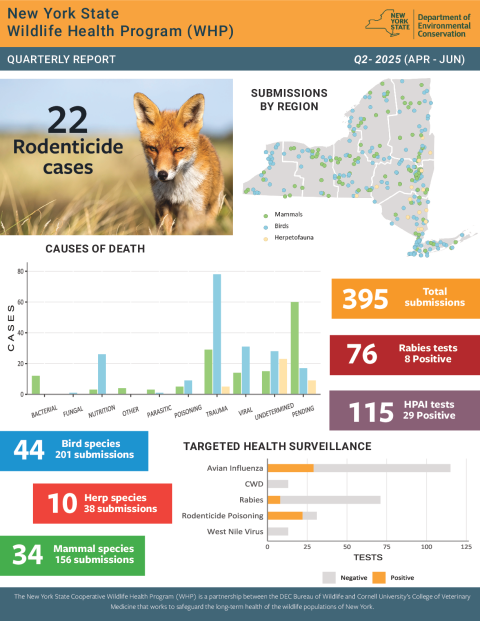
395 total submissions
76 Rabies tests - 8 positive
115 HPAI tests - 29 positive
44 Bird species across 201 submissions
10 Herp species across 38 submissions
34 Mammal species across 156submissions
*22 Rodenticide detections