Mange Response – Public Inquiry
General Facts
- Not all hair loss is caused by mange.
- Mange is caused by microscopic mites and is easily transmitted to other mammals, including humans.
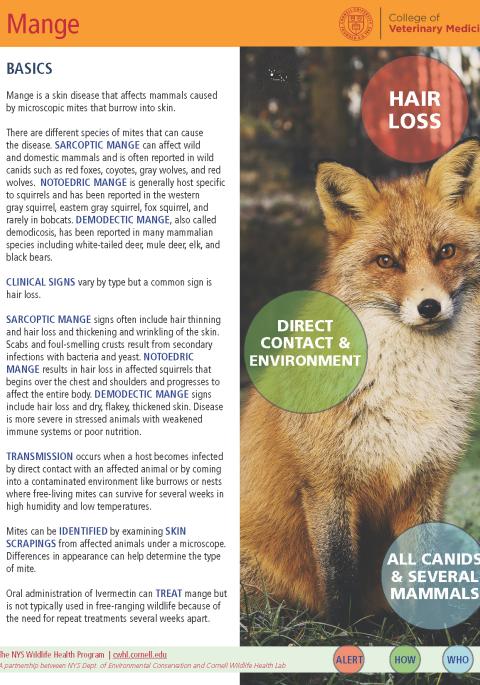
- Some wildlife can recover from mange without intervention, but infections in red foxes are often fatal.
- Infected animals often have or develop secondary infections and nutritional deficits. Only treating the mites does not address other conditions.
- Do not try to handle or feed sick wildlife, even if they approach you. Contact a licensed wildlife rehabilitator, Environmental Conservation Officer, or local police if a sick animal is aggressive or not leaving your yard.
Treatment Information *Do not attempt to provide any medications to free-ranging wildlife*
- Current recommendations are to euthanize moderate to severely affected individuals to reduce suffering and disease transmission. The treatment of mites should only be done under direct veterinary supervision on captive animals to prevent:
- Incorrect and insufficient dosing, which risks the animal's health.
- The development of treatment-resistant mites, making future infections harder to treat.
- The accidental treatment of non-target animals, which can be lethal for some species or negatively impact the health of others.
*Find a licensed wildlife rehabilitator near you: NYSDEC Wildlife Rehabilitators
Please contact Cornell Wildlife Health Lab for more information on mange at: cwhl@cornell.edu
Wildlife Rehabilitator Treatment Considerations
- Proper treatment requires proper diagnosis. Skin scrapings and microscopic identification of the mite species are the gold standard.
- Individuals with mange have more successful outcomes when treatment is paired with supportive care. Supportive care requires admission into a rehabilitation facility where the animal can be monitored closely and given supplemental food and adjunct treatments.
- In naïve populations where mange is not yet endemic, natural deaths from mange may play a critical role in natural selection and evolution of resistant animals. Thus, in populations that are not of conservation concern (e.g. threatened or endangered), mange treatment may actually limit natural selection.
- Ideal criteria for considering mange treatment (Rowe et al. 2019): 1) severity of infection, 2) likely success of treatment, 3) post-release survival and re-infection rates, 4) conservation status of the animal, and 4) likelihood of the animal transmitting infection to another species if left untreated. Recent research has also highlighted that body condition (e.g. emaciation) may be a significant factor in the likelihood that individual animals will respond to treatment or possibly recover from mange on their own.
- Further studies in wildlife are needed to understand the potential side effects of treatment, long-term protection, drug residues in tissues, and concerns for human safety in animals hunted for consumption.
- Further study is needed to understand the development of resistance to treatment in mites. Incomplete treatment regimens (e.g. single doses of ivermectin, lower than recommended doses) are suspected to contribute to resistance. Ivermectin drug resistance has recently been documented in humans.
*Licensed rehabilitators requesting additional treatment guidance, email: SpecialLicenses@dec.ny.gov