The Background
For decades, wildlife health professionals around the northeast US detected patterns of lead toxicosis in bald eagles. At first, the origin of the lead (Pb) was unknown, but soon fragments of spent Pb-ammunition were discovered in x-rays of their stomachs.
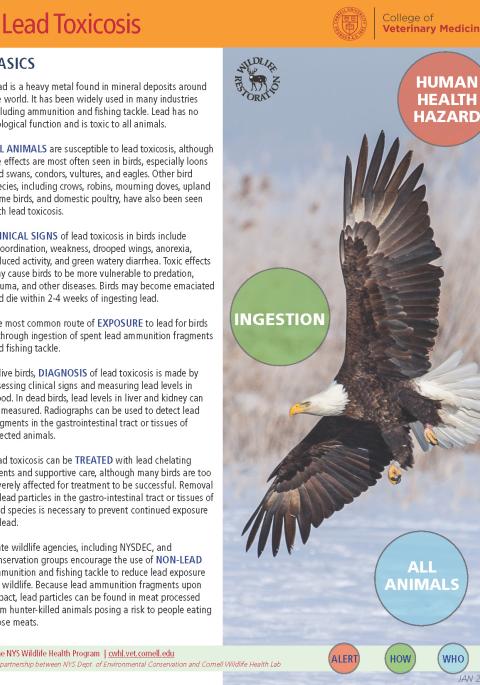
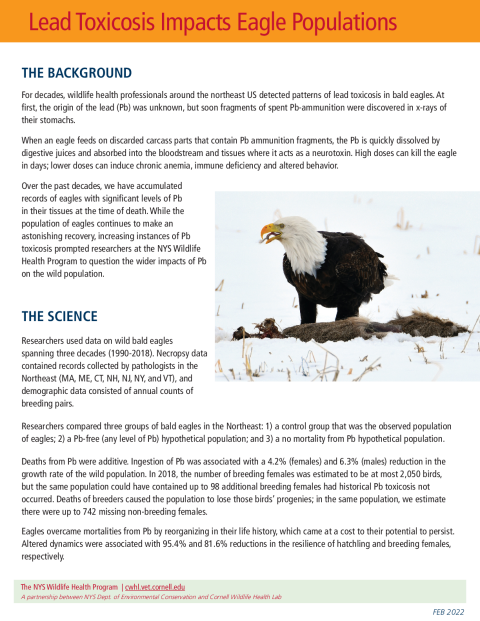
When an eagle feeds on discarded carcass parts that contain Pb ammunition fragments, the Pb is quickly dissolved by digestive juices and absorbed into the bloodstream and tissues where it acts as a neurotoxin. High doses can kill the eagle in days; lower doses can induce chronic anemia, immune deficiency and altered behavior.
Over the past decades, we have accumulated records of eagles with significant levels of Pb in their tissues at the time of death. While the population of eagles continues to make an astonishing recovery, increasing instances of Pb toxicosis prompted researchers at the NYS Wildlife Health Program to question the wider impacts of Pb on the wild population.
Researchers used data on wild bald eagles spanning three decades (1990-2018). Necropsy data contained records collected by pathologists in the Northeast (MA, ME, CT, NH, NJ, NY, and VT), and demographic data consisted of annual counts of breeding pairs.
Researchers compared three groups of bald eagles in the Northeast: 1) a control group that was the observed population of eagles; 2) a Pb-free (any level of Pb) hypothetical population; and 3) a no mortality from Pb hypothetical population.
Deaths from Pb were additive. Ingestion of Pb was associated with a 4.2% (females) and 6.3% (males) reduction in the growth rate of the wild population. In 2018, the number of breeding females was estimated to be at most 2,050 birds, but the same population could have contained up to 98 additional breeding females had historical Pb toxicosis not occurred. Deaths of breeders caused the population to lose those birds’ progenies; in the same population, we estimate there were up to 742 missing non-breeding females.
Eagles overcame mortalities from Pb by reorganizing in their life history, which came at a cost to their potential to persist. Altered dynamics were associated with 95.4% and 81.6% reductions in the resilience of hatchling and breeding females, respectively.
Deaths from Pb toxicosis are an anthropogenic problem with an anthropogenic solution. Take action to refrain from making Pb fragments available to eagles and other scavengers. Potential actions include (1) using non-Pb ammunition; (2) packing out the entire carcass, including the guts, containing the spent Pb-based ammunition; (3) burying the offal or carcass parts containing spent Pb-based ammunition, such that Pb-fragments are no longer available to scavengers. Encourage others to do the same.
Based on the available data integrated into a theoretical bald eagle math equation, predictions can be made to compare the survival of sexes and ages between lead and non-lead groups.
Citations:
Hanley, B., J, A. A. Dhondt, M. J. Forzán, E. M. Bunting, M. A. Pokras, K. P. Hynes, E. Dominguez-Villegas, and K. L. Schuler. 2021. Environmental lead reduces the resilience of bald eagle populations. Journal of Wildlife Management 1–18. https://doi.org/10.1002/jwmg.22177
Hanley, B. J., A. A. Dhondt, B. Dennis, and K. L. Schuler. 2019. Using time series data to assess recent population dynamics of bald eagles in the northeast United States. Ecosphere 10:1–11. https://doi.org/10.1002/ecs2.2963