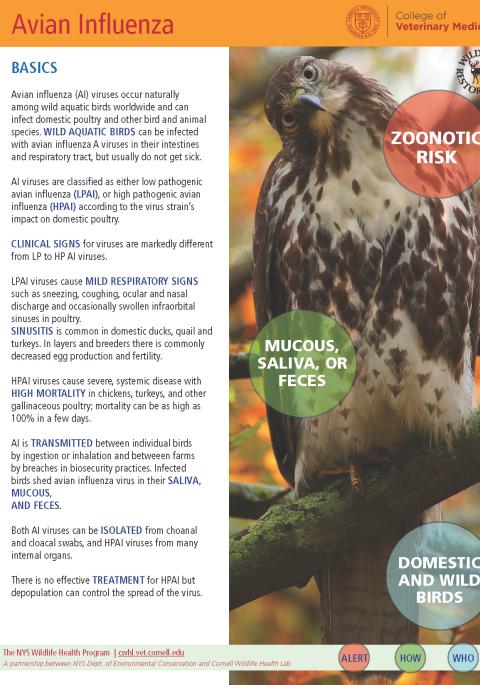
Highly Pathogenic Avian Influenza (HPAI) continues to infect birds and mammals across the US and Canada, including New York. Avian influenza is caused by an influenza type A virus that is carried by free-flying waterfowl and other waterbirds such as ducks, geese, and shorebirds, but can also infect domestic poultry (chickens, turkeys, pheasants, quail, domestic ducks, geese, and guinea fowl), raptors, corvids, and mammals. Some infected wild birds can carry these viruses without getting sick, but domestic poultry and many wild bird species can get very sick and often die from them. Songbirds and other passerine birds do not appear to be highly susceptible to infection. Avian influenza virus infections follow a seasonal pattern tied to bird migration, with cases peaking in late fall and winter and declining in the spring. Cases can be seen year-round.
The U.S. Centers for Disease Control and Prevention states that the recent HPAI detections in birds pose a low risk to the public. As of the making of this document, 71 human cases of H5N1 avian influenza have been detected in the United States, including two mortalities. Infected birds shed avian influenza viruses in their saliva, mucus, and feces. Human infections with avian influenza viruses can occur when enough virus enters a person’s eyes, nose, or mouth, or is inhaled. There is likely little risk for the public, but people with close or prolonged unprotected contact with infected birds or virus-contaminated environments, especially immunocompromised people, will be at greater risk of infection. Wildlife rehabilitators should follow the PPE guidelines below when handling potentially infected animals.
The first detection of HPAI in New York was in a backyard poultry flock in Suffolk County on February 19, 2022. HPAI has been detected in free-ranging wild birds and mammals throughout the state. At this point, it is likely widespread, even in counties where it has not yet been detected. Wild bird species confirmed as infected in New York include snow goose, Canada goose, trumpeter swan, tundra swan, mute swan, sanderling, black-headed gull, black skimmer, crested screamer, common tern, Caspian tern, herring gull, great black-backed gull, ring-billed gull, American black duck, Baikal teal, bufflehead, American wigeon, gadwall, greater scaup, green-winged teal, lesser scaup, mallard, northern pintail, northern shoveler, redhead, ring-necked duck, wood duck, pied-billed grebe, hooded merganser, red-breasted merganser, common loon, great blue heron, snowy egret, double-crested cormorant, bald eagle, peregrine falcon, merlin, barred owl, eastern screech owl, great horned owl, snowy owl, cooper’s hawk, red-shouldered hawk, red-tailed hawk, American crow, common raven, fish crow, ring-necked pheasant, ruffed grouse, wild turkey, black vulture, and turkey vulture.
In addition to the many species of wild birds, HPAI has been confirmed in mammal species, including wild red fox, gray fox, muskrat, striped skunk, Virginia opossum, raccoon, eastern gray squirrel, and bobcat. While these are the only species with confirmed HPAI in New York, HPAI has also been found in a wide range of taxa, particularly carnivores, in other parts of the United States.
The USDA and NY Department of Agriculture and Markets lead the disease response in domestic and captive flocks, which includes testing, quarantine, and possible depopulation of infected domestic birds. There is no way to contain the infection in wild birds. Poultry and gamebird facilities, falconers, and backyard flock owners should be extremely cautious in their biosecurity measures to prevent transmission. Falconers and hunters should avoid having their birds and dogs consume any at-risk species, including waterfowl and shore birds.
Since HPAI is contagious between birds and has been detected in mammals, it is important for wildlife rehabilitators to be aware of the risk of introducing HPAI to their facility. Practicing strict biosecurity protocols can reduce the risk to other wildlife patients and education animals. The following guidelines should help reduce the risk of HPAI infections at rehabilitation facilities.
Report any suspect HPAI mortalities to the NYS Wildlife Health Program or your Regional DEC Wildlife Staff (see contact information below).
Testing is required to diagnose avian influenza virus infection. Confirmatory testing should be performed at approved laboratories. Any live wild bird that tests positive for HPAI on intake should be euthanized and reported immediately to the NYS Wildlife Health Program. If HPAI infects a number of animals under care, the facility may be quarantined pending an investigation.
Clinical Signs
Be aware that the clinical signs for HPAI infection in wildlife are non-specific and may be similar to other diseases or injuries. Waterfowl, waterbirds, raptors, and scavenging birds are at higher risk of infection, but any species could potentially be infected, including mammals. HPAI-infected animals may be asymptomatic or may exhibit signs of respiratory distress (sneezing, nasal discharge), lethargy, neurologic malfunction (ataxia, stargazing, or seizures), diarrhea, weakness, or sudden death.
Personal Protective Equipment (PPE)
Although this strain of HPAI does not pose a risk to the general public, wildlife rehabilitators are more likely to have close contact with infected animals, so they are at greater risk. Dedicated clothing or coveralls and shoes, disposable gloves, a disposable N95 face mask, and a face shield or eye protection are recommended when working with potentially infected wildlife, including while transporting in a vehicle. Carriers and vehicles should be disinfected between animals. During transportation, consider covering carriers with a blanket to reduce aerosol exposure and placing them on an easily disinfected or disposable surface, such as a plastic liner. Keeping current with the annual flu vaccine is also recommended to reduce the risk of co-infection with seasonal flu viruses. Monitor your health for any signs of flu-like symptoms within 10 days of handling wild birds or mammals suspected or confirmed infected with HPAI, and consult your health care provider if you have any questions.
Quarantine
Admitted birds should be quarantined for at least 30 days in a separate room, preferably in a separate building, to avoid shared air space. HPAI infections can spread quickly between birds in close quarters. The virus is shed in respiratory fluids, mucus, and feces; it can be aerosolized by sneezing or coughing or in dust. Birds can be quarantined as a cohort as needed. Best practice is to have separate staff tending to quarantined birds and admissions, otherwise attend to quarantined animals at the end of the day and wear dedicated clothing and shoes in that area. Disinfectant footbaths at the entrance/exit of the quarantine area can be used in lieu of changing shoes.
Euthanasia
Any bird that has clinical signs suggestive of HPAI (and not attributable to trauma or toxicity) should be euthanized immediately without being admitted to the facility. There is no treatment for HPAI. Especially during migration seasons (fall to spring), all neurologic geese, ducks, and raptors should be suspected as HPAI-positive. Any facility that cannot adhere to these euthanasia and quarantine guidelines should consider suspending intake of new birds.
Disinfection
Crates, carriers, food and water dishes, staff clothing, and other objects that a potentially infected animal contacts should be disinfected after use. Avian influenza virus can be killed with many disinfectants, including bleach. Household bleach with a 5-6% sodium hypochlorite concentration should be mixed at a ratio of 1 part bleach to 9 parts water. A 10-minute contact time is required. Organic material (dirt, feces, etc.) must be removed prior to disinfection.
Disposal
Carcasses of suspect animals should be triple-bagged and placed in the household trash. PPE used to handle the carcass can be included prior to the third bag. Wildlife rehabilitators should not collect dead birds from the landscape for disposal. Rather, dead birds should be reported to the NYS Wildlife Health Program or your Regional DEC Wildlife Staff (see contact information below). Staff at these facilities will determine whether to collect the carcass.
Domestic and Education Animals
Domestic chickens, turkeys, ducks, geese, and pheasants are all highly susceptible to HPAI infection, so if you keep, or have contact with, these birds or education raptors, you should shower and change clothes and shoes before tending to them or arrange for someone else to take care of them until an outbreak subsides. HPAI has also been detected in dairy cows and domestic cats, so avoid contact with these animals or be sure to shower and change prior to interacting with them. Do not allow cats or other pets to have contact with suspect HPAI carcasses.
Raw Food
HPAI has been detected in raw pet food and milk products, so avoid handling and feeding these products to any animals.
NYS Wildlife Health Program contact information to report suspect birds in NY:
- Cornell Wildlife Health Lab
- DEC: wildlifehealth@dec.ny.gov or 518-478-2203