Project Background
Wildlife are indicators of ecosystem health. Among wildlife, waterfowl can ingest pollutants from their environment, which we can consume when we hunt and eat the birds. Historical studies have addressed pollutants in wildlife leading to consumption advisories, but a lot has changed with the world over the last few decades since those advisories were issued. We wanted to collect current data to study contaminant loads of commonly hunted waterfowl to know if or to what extent pollution in the environment is making its way onto our dinner tables.
We collected data on pollutant levels in five species of popular waterfowl: green-winged teal, black ducks, wood ducks, Canada geese, and mallards. We set up our study to obtain randomly selected birds (and not just birds that lived by known sources of pollution) to compute ‘baseline’ levels of contamination across the northeast portion of the Atlantic Flyway.
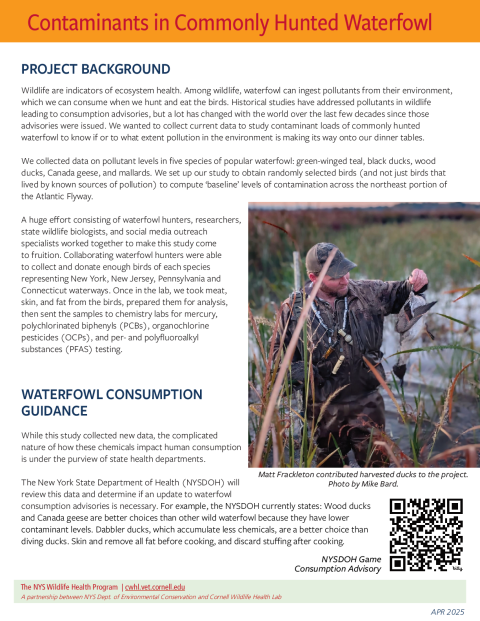
A huge effort consisting of waterfowl hunters, researchers, state wildlife biologists, and social media outreach specialists worked together to make this study come to fruition. Collaborating waterfowl hunters were able to collect and donate enough birds of each species representing New York, New Jersey, Pennsylvania and Connecticut waterways. Once in the lab, we took meat, skin, and fat from the birds, prepared them for analysis, then sent the samples to chemistry labs for mercury, polychlorinated biphenyls (PCBs), organochlorine pesticides (OCPs), and per- and polyfluoroalkyl substances (PFAS) testing.
While this study collected new data, the complicated nature of how these chemicals impact human consumption is under the purview of state health departments.
The New York State Department of Health (NYSDOH) will review this data and determine if an update to waterfowl consumption advisories is necessary. For example, the NYSDOH currently states: Wood ducks and Canada geese are better choices than other wild waterfowl because they have lower contaminant levels. Dabbler ducks, which accumulate less chemicals, are a better choice than diving ducks. Skin and remove all fat before cooking, and discard stuffing after cooking.

Visit NYSDOH Game Consumption Advisory-Harvesting, Preparing, and Eating Wild Game that provides advice for hunters and families consuming wild game.
Overall, the data from this study suggest that Canada geese and wood ducks had lower contaminant levels than green-winged teal, black ducks, and mallards, although we did find PCBs and at least one OCP and PFAS in every bird in the study. Our calculations suggest that mercury and OPCs remain within current advisory standards. Our study also demonstrates that commonly hunted waterfowl are frequently exposed to chemicals in the environment. The obvious next step is to evaluate how these pollutants impact waterfowl reproduction, immune function, and survival, and whether pollutants alter population dynamics in a way that jeopardizes overall population sustainability. Understanding how pollutants may impact different species can help maintain viable waterfowl populations for years to come.

Thanks to our partners:
New York State Department of Environmental Conservation, Pennsylvania Game Commission, Connecticut Department of Energy and Environmental, New Jersey Fish and Wildlife; New York State Department of Health, and Wildlife Futures Program at the University of Pennsylvania School of Veterinary Medicine.
Citations:
Dayan D, Hanley B, Stiller J, Richter W, Gregg I, Huck N, Huang M, Nichols T, Spliethoff H, Becker J, Murphy L, Schuler K. 2025. Environmental contaminants assessment for frequently harvested migratory waterfowl in the Northeast Atlantic Flyway. Science of the Total Environment. https://doi.org/10.1016/j.scitotenv.2025.178474.
The data can be found here:
Dayan D, Hanley B, Schuler K. 2024. Ecotoxicology data package: contaminants in migratory waterfowl in the Northeast United States. Cornell University Library eCommons Repository. https://doi.org/10.7298/0sss-m363.
*This study was supported by funding from the 2022 Multistate Conservation Grant Program # F22AP00575–00, administered jointly by the U.S. Fish and Wildlife Service and the Association of Fish and Wildlife Agencies.