

In April 2026, Melissa Fadden and wildlife intern Julia joined Rich Pendleton, a Research Support Specialist III with the New York State Department of Environmental Conservation Division of Marine Resources/Cornell University’s Hudson River Estuary Management Program, for a day on the water learning about their long-term monitoring surveys for Atlantic sturgeon (Acipenser oxyrinchus oxyrinchus). Listed as endangered under both state and federal laws, this data collection is part of a broader cooperative effort managed by the Atlantic States Marine Fisheries Commission to inform the species' recovery objectives. Although the Atlantic sturgeon fishery was shut down in 1998, these prehistoric animals remain vulnerable to a wide variety of anthropogenic threats, and research indicates the population is still severely depleted in New York compared to historic levels.
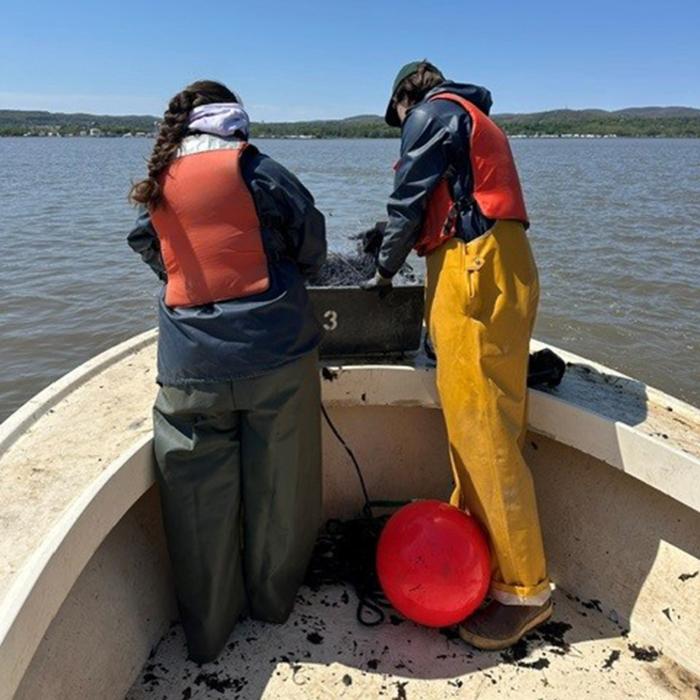
Despite the crew setting and checking multiple gill net sets to catch juvenile Atlantic sturgeon for morphometrics, genetic sampling, and release, they were unrewarded.
Although they did not catch the target species, they pulled up multiple shortnose sturgeon, channel catfish, white catfish, and an adult American eel. Shortnose sturgeon (Acipenser brevirostrum) are also an endangered species and are managed at both the state and federal levels because they are primarily non-migratory and tend to remain in their natal waters (the southern population does exhibit some movement between rivers). Although they are not the target of this survey, researchers are also studying shortnose sturgeon, so they received much the same treatment as the Atlantics: weight, length, genetic sample, and individual marking via PIT tag. They were then safely released back to the murky depths of the Hudson River, as was the rest of the bycatch.
Well-versed in terrestrial species, it was valuable for both visitors to see the aquatic side of endangered species monitoring and management, and we thank Rich for his invaluable information and skill-sharing!